
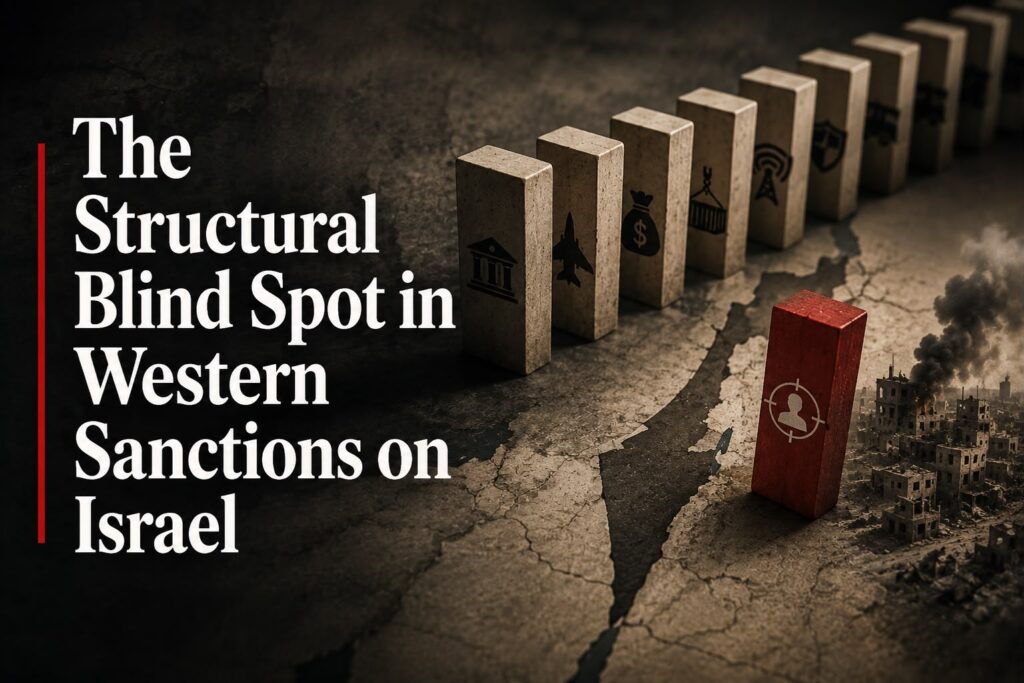
Whenever Western countries implement sanctions against a selected few associated with the Israeli government or settler groups, the rhetoric often focuses on the positive aspects, such as accountability, punishment for wrongdoing, and adherence to international laws. However, beyond all the rhetoric lies a much more contradictory trend that is becoming increasingly prevalent in the global reaction towards the Israeli-Palestinian conflict. Sanctions and measures continue to be adopted and applied on the fringes, while the fundamental structure continues to stay intact.
A current example of such sanctions aimed at settlers and extremists in the West Bank is relevant. On the surface, it seems to signify an ideological change: Western states have realized that the violence by settlers should be recognized as part of a broader policy of dispossession. Yet this policy can be described as limited in its reach: It targets specific persons and groups, while leaving the entire structure supporting settlements completely untouched. Thus, the more Western governments act, the more they risk obscuring inaction at the structural level.
This is important because, in this context, settlement expansion is not an incidental aspect of Israeli policies, but rather a fundamental part of it. Everything from infrastructural development to security provisions and funding allocations supports this process. From this point of view, settler violence is not something external to the state policy, but rather its manifestation. The point where state and actor blur together arises when the settlers use arms in their assault on Palestinian villages protected by the military or expand their domain using state infrastructural development projects.
This is where the comparison with other geopolitical crises becomes unavoidable. When Russia’s invasion of Ukraine began, the international response was immediate and systemic. Entire sectors of the Russian economy were targeted, major financial institutions were cut off from global systems, and a broad coalition moved in synchrony. The guiding assumption was that sustained pressure on the state apparatus itself was necessary to alter behavior. Whether or not that strategy is ultimately successful is a separate debate. What is notable is the consistency of its application.
For Israel, the response has continued to be fragmented. As criticisms for crimes against humanity and the suffering of civilians continue to pervade international discourse, the policies pursued continue to be those that do not touch the core elements of state policy but are geared toward symbolism, such as ministers known for their extreme rhetoric, settler organizations, or even money laundering in support of terrorism. In effect, the core elements that perpetuate the problem have been protected.
One possible explanation is rooted in the political structure of Western alliances. Israel is not regarded in terms of being a traditional target of international pressures, just like other countries. Instead, it belongs to a separate group which is defined through the historical context, security considerations and political limitations of Western nations. This approach means that policies are carefully adjusted so as not to disrupt the entire system of relations between states.
The result is policy compartmentalization. While one level acts to treat the symptoms by responding to a particular instance of violence or perpetrator, the other level serves to keep the existing order intact. This system is precisely what results in the perception of double standards being increasingly recognized as an issue in global governance.
There is also a political dimension within Israel itself that complicates the effectiveness of targeted sanctions. Far-right settler movements and political actors operate within a system that, at minimum, tolerates and often facilitates their activities. This does not mean that all state institutions act uniformly, but it does indicate that enforcement against them cannot be separated from the political environment that enables them. In such conditions, isolating individuals has limited practical impact, as long as institutional support structures remain unchanged.
It prompts a larger issue regarding the intent behind sanctions. Where the goal is to effect behavioral change, it is likely that any strategy that circumvents the key decision-making process will fail to achieve its goal. But where the intention is merely to send a signal, then it would be more effective in domestic politics but not in changing any tangible situation. The divide between intention and effect cannot help but grow larger as violence becomes more cyclical and nothing changes structurally.
In parallel, the humanitarian angle of the dispute remains equally compelling for observers. In Gaza and the occupied territories, ongoing waves of devastation have created an environment well beyond any simple political confrontation. Basic facilities and economic sustainability are consistently undermined. In this context, limited sanctions against peripheral actors appear disconnected from the scale of the crisis they are meant to address.
Ultimately, the core dilemma facing Western policymakers is not about lacking the instruments to make an impact, but about their hesitancy to use them effectively. Policymakers may be ready to impose sanctions on individuals, make declarations, and restrict in certain ways, yet much less willing to address the underlying system that causes all these problems.
The long-term risk of this approach, then, over the long term is that of losing credibility. The use of legal principles in a discriminatory fashion undermines their ability to persuade. Accountability, if it appears as something limited to certain individuals, loses its capacity to serve as an all-encompassing principle. And if structures remain intact, violence remains cyclical.
This controversy, however, is not merely one regarding Israel alone. It pertains to the very consistency of the international system as such. If the system treats identical situations differently based on location or alliance, it cannot be said to be applying rules. Rather, it will be making exceptions, and these exceptions will ultimately determine the rule.