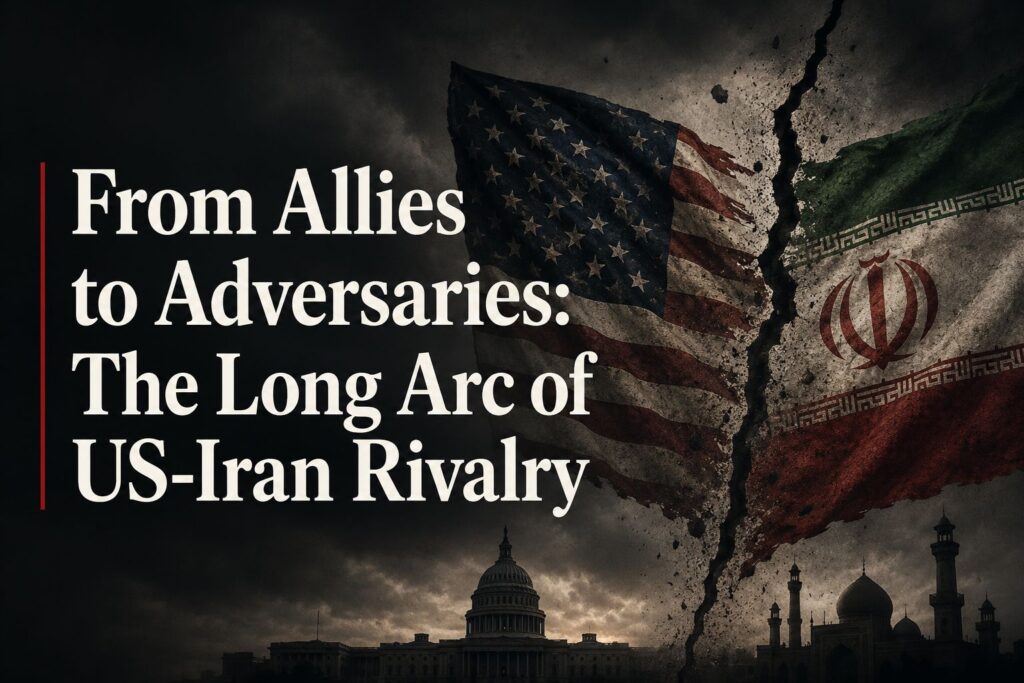
The US-Iran conflict could arguably be seen as the most serious and combustible relationship in contemporary international politics. In contrast to other cases of diplomatic relations, the case of the United States and Iran has developed in light of mutual distrust, bad strategic decisions, conflicting ideologies, and conflicting interests in relation to regional hegemony. Although the two countries had cooperated successfully at the time of the Cold War, their relations after the Iranian revolution of 1979 proved how quickly friendship may become a thing of the past.
The 1953 Coup: The Foundational Rupture
It can be argued that the most critical single event defining the recent history of US-Iran relations occurred in 1953 when the US overthrew the democratically elected Prime Minister of Iran, Mohammad Mossadegh. In 1951, Mohammad Mossadegh had nationalized the Iranian oil industry, bringing an end to British domination over the Anglo-Iranian Oil Company (later renamed as BP).
By August 1953, the CIA and MI6 conducted a joint operation dubbed ‘Operation Ajax’, which resulted in the downfall of Mossadegh and consolidation of the absolutist power of Shah Mohammad Reza Pahlavi. It is stated that the coup took place against a backdrop of growing fears that the Iranian state could fall under Soviet influence during the Cold War era.
As a result, Shah Mohammad Reza Pahlavi was transformed into a loyal ally of America, who received substantial military, economic, and intelligence assistance. Unfortunately, the Shah’s dictatorship, which enjoyed American backing, was marked by brutal methods, employed by the notorious intelligence agency SAVAK. The legacy left behind by this period in terms of Iranian political discourse is clear: Iran sees itself as a victim of direct foreign intervention.
Cold War Alignment and Strategic Cooperation
Despite underlying resentment, US-Iran relations during the Shah’s reign (1953-1979) were characterized by close strategic cooperation. Iran was viewed in Washington as a cornerstone of the “Northern Tier” containment strategy against the Soviet Union.
The signing of civil nuclear cooperation between the two nations took place in 1957 as part of the U.S. “Atoms for Peace” program. The nuclear aspirations of Iran were backed by the West through education and transfer of technologies.
Iran, during the decades of the 1960s and 1970s, was one of the largest beneficiaries of the American weapons supplies.
During the years at their height, the Iranians served not just as allies, but rather as the gendarmerie for American interests in the Persian Gulf. On the other hand, however, this alliance did have a number of internal contradictions within itself.
1979 Revolution: The Strategic Earthquake
Islamic Revolution in 1979 was a clear turning point. The Shah was ousted, and Islamic Republic was established by Ayatollah Ruhollah Khomeini. The Islamic Republic rejected monarchy and the West altogether.
This revolution changed Iran from an ally country to hardline opponent. The tensions peaked when Iranian students stormed the US embassy and took hostages of fifty-two American diplomats for a period of 444 days.
The hostage situation broke off diplomatic ties and created mutual antagonism within both nations on a societal level. Sanctions were imposed by the US on Iran and all diplomatic ties between the two countries were broken. Iran retaliated to this by dubbing the US as the “Great Satan.”
The 1980s: Proxy Conflict and Regional Militarization
During the 80s, tension reached its highest level mostly because of indirect confrontation. The era of Iran-Iraq war (1980-1988) was marked by the indirect aid that America was giving to Iraq in order to weaken revolutionary Iran.
Even worse was the situation with confrontations on the sea in the Persian Gulf, such as Operation Praying Mantis launched by the US Navy in 1988 that led to the destruction of Iranian Airlines Flight 655 resulting in 290 innocent victims.
Finally, the exposure through the Iran-Contra affair showed the complexity of US foreign policy when, although rejecting any contact with Iran, they actually supplied them with weapons in exchange for released hostages, which proved that their relations were based only on pragmatism.
Post-Cold War Era: Sanctions and the “Axis of Evil”
Rather than normalizing relations after the Cold War, the United States’ relationship with Iran became one based on sanctions and containment.
Full economic sanctions were imposed on Iran by the US in the energy and finance sectors in 1996. However, after the September 11 attacks in 2001, Iran temporarily cooperated with the US in the fight against the Taliban in Afghanistan. But this opening quickly closed.
President George W. Bush included Iran into his “Axis of Evil” along with Iraq and North Korea in 2002. It made relations between the two countries more hostile and silenced those Iranians who called for cooperation with the Western world.
Nuclear Dispute and the JCPOA
The greatest strategic problem in the beginning of the 21st century was the Iranian nuclear program. The West had concerns about the possibility that Iran might develop nuclear weapons, while Iran insists that their program has no military purposes at all.
The year 2015 saw a conclusion of an agreement between Iran and the P5+1 countries (the US, the UK, France, Russia, China, and Germany), which was called the Joint Comprehensive Plan of Action (JCPOA). Iran agreed to certain restrictions concerning uranium enrichment in return for the easing of sanctions against them.
Unfortunately, however, the deal failed, as the US withdrew from it under President Donald Trump in 2018, applying tough sanctions to the financial and oil sectors in Iran. These sanctions have drastically reduced Iran’s exports of oil and resulted in economic decline, inflation, and depreciation of the national currency.
Escalation Phase: 2020–2026
Things heated up rapidly following the assassination of Iranian General Qassem Soleimani by the United States in 2020. He was an influential figure when it comes to the military operations of Iran in the region. This was followed by missile attacks launched by Iran at US stations in Iraq.
In subsequent years, proxy conflicts expanded across Iraq, Syria, Lebanon, and Yemen, while cyber operations and maritime incidents in the Gulf intensified.
The emergence of periodic Israeli attacks on Iran’s nuclear facilities and increased US military deployment in the Gulf region by the mid-2020s added more complications to the regional dynamics. With recent events showing the collapse of any attempts at nuclear diplomacy, it is evident that the post-JCPOA arrangement has failed.
A Rivalry Locked in History
The relation between the US and Iran is much more than a geopolitical rivalry, it has become a historical framework for grievances fueled by ideology and memories and repetition of the cycle of escalation. For Iran, 1953 has remained an important year in terms of intervention. As for the United States, Iran after 1979 has been seen as a threat.
Seventy years later, however, the competition has only fed upon itself. Each confrontation empowers the hardline factions in both countries, while the moderates find it difficult to maintain any diplomatic momentum. With no major restructuring of the security and sanction frameworks as well as power dynamics in the region, US-Iranian relations will continue their trajectory of managed confrontation.