
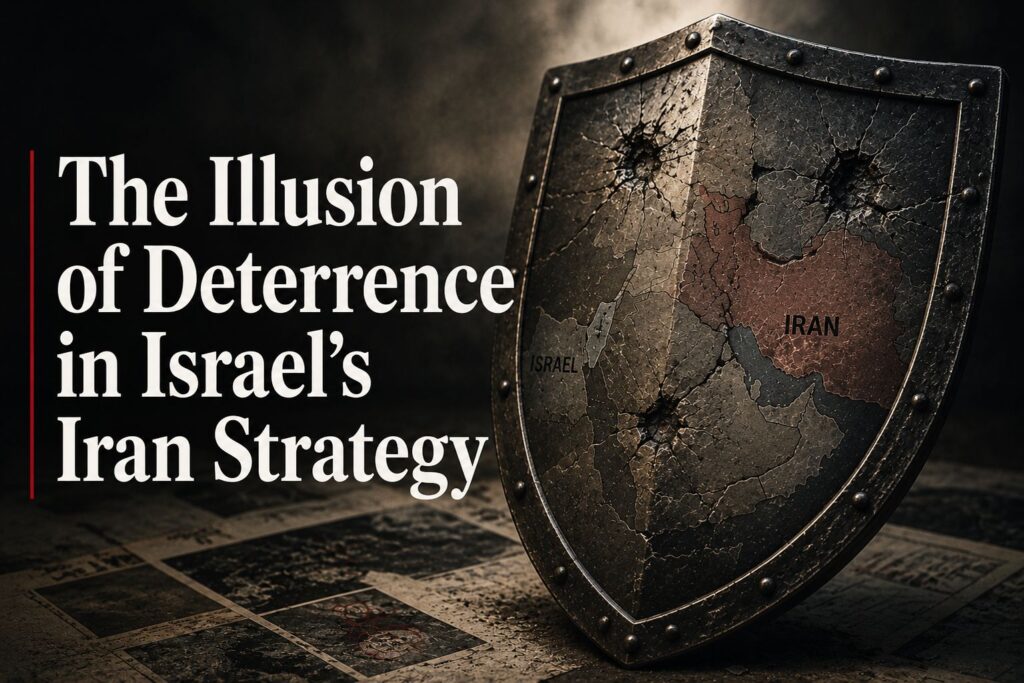
Assessments by former Israeli military intelligence analysts have rekindled an uncomfortable debate in strategic discussions on whether Israel’s multiple military engagements with Iran have helped secure its security interests or instead inadvertently undermined them. In the opinion of Danny Citrinowicz, who used to serve as a senior Iranian affairs analyst at the Israeli army’s intelligence branch, neither engagement, that of the unilateral Israeli strikes against Iran in 2025 nor that involving the US and Israel together in early 2026, managed to accomplish its intended goal of discouraging Iran’s nuclear pursuits.
The core of this new assessment is a well-known irony of modern warfare. The basis of Israel’s strategy has always rested on the idea that superior intelligence and control of airspace will impose such high costs on its enemies that they have no choice but to recalculate. In light of the actions taken by Iran after each blow, however, this expectation seems misguided.
Citrinowicz’s critique highlights a core misjudgment, what he describes as an overestimation of air power and an underestimation of Iranian resilience. Despite sustained military pressure, Iran retains not only its missile and drone capabilities but also the institutional capacity to regenerate them under sanctions and continued surveillance pressure. More significantly, it has preserved the core infrastructure of its strategic deterrence doctrine, including the latent possibility of nuclear breakout capability.
This raises an important question for Israeli policymakers: what constitutes success in a campaign whose primary objective is prevention rather than conquest? If Iran’s nuclear progress is delayed but not halted, and if its regional posture becomes more decentralized rather than constrained, can such operations still be considered strategic victories?
Perhaps the single most important aspect of this emerging conflict is not its military component, but rather its psychological and ideological components. Israeli doctrine has always emphasized the idea of coercive deterrence based on massive reprisal. However, from a psychological standpoint, the Iranian response demonstrates an adaptation to life under constant military threat. As noted by Citrinowicz, Iran is learning to accept the notion of consistent attacks while continuing its activities without a hitch.
Equally significant is the claim that these operations have altered Iran’s perception of vulnerability. Whereas Iranian leadership once viewed direct strikes as a prohibitive threshold that could destabilize the regime, repeated attacks by both Israel and the United States appear to have demonstrated that regime survival is not immediately threatened by even the most advanced air campaigns. This recalibration of risk perception may carry profound implications: rather than deterring nuclear ambitions, it may reinforce Tehran’s incentive to pursue a credible nuclear deterrent as the ultimate insurance against future attacks.
This is when the phenomenon known as the “boomerang effect” takes on strategic importance. The military maneuvers meant to retard the development of nuclear weapons could potentially spur the need for nuclear weapons by the state. There is precedent in history, although sparse, that demonstrates this point.
The regional ramifications beyond the country itself are also quite complicated. The dependency of Israel on working with the US in operations with a high degree of intensity indicates its technical prowess and strategic dependency. Even though combined operations show compatibility as well as intelligence gathering capabilities, they also highlight an asymmetrical relationship in which Israel has strategic reach, but not independent reach. Some observers see this dependency as having potential ramifications for operational freedom in the future should there be a divergence in political goals.
However, the diplomatic efforts aimed at the expansion of the Abraham Accords are becoming increasingly doubtful in light of the continuation of the conflict. Predictions regarding the fast-paced normalization of the region that include even Saudi Arabia’s possible involvement seem to be completely disconnected from the actual situation where military escalation is occurring.
Nothing in this assessment can be interpreted as saying that the use of force does not have any impact at all. Force does cost, creates delays, and demonstrates commitment. However, the accumulation of evidence leads us to conclude that such measures, standing alone, no longer seem sufficient for strategic change. Indeed, they may be part of an escalatory process of adaptation without any real change in the power balance.
Ultimately, the question confronting Israeli strategy is whether deterrence can be restored through repetition of the same operational logic, or whether a fundamentally different political and diplomatic framework is required. As Citrinowicz’s assessment implies, the danger is not merely that operations fail to achieve their stated objectives, but that they gradually redefine what failure looks like in the first place. If Iran emerges from repeated strikes with its regime intact, its deterrence posture hardened, and its nuclear threshold ambiguity preserved, then the strategic equation may have shifted in ways not anticipated by planners.
In that sense, the most significant consequence of the Iran confrontations may not be immediate battlefield outcomes, but the slow erosion of confidence in the assumption that military superiority alone can engineer strategic advantage in the Middle East.