
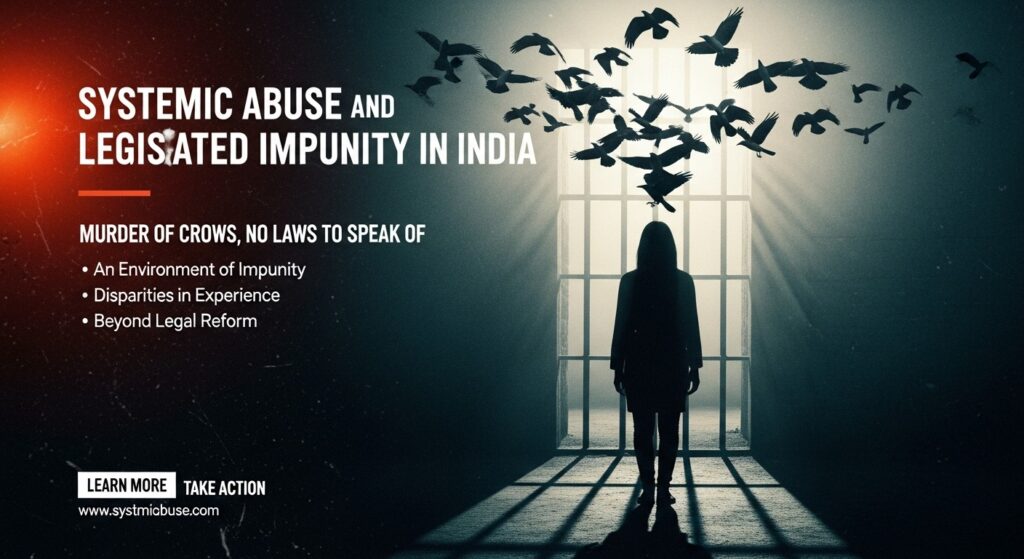
India is but a constitutional republic and its heralded status as the largest democracy in the world, which is purportedly run on principles of rule of law, dignity. Yet there is a sinister, sadistic reality behind its police stations and detention centers: torture is not an aberration; it is merely an ordinary course of business for the state. With evidence by national civil society organizations and international human rights groups accumulating in spite of something that, on first glance seems jarring to say, custodial abuse in India is neither incidental nor unfortunate; it is systemic and the legal approaches being used to deal with it have apparently not been effective.
Murder of Crows, No Laws to Speak Of
One of India s pervasive human rights shortcomings is its refusal to ratify the UN Convention Against Torture (UNCAT). India signed the treaty in 1997, nearly three decades ago, but still has not ratified it so is free from international legal obligation to outlaw torture. In addition, there is not a narrow definition or national prohibition law on torture. The Indian Penal Code does contain general and erstwhile stringent provisions a will, but it fails to directly address the nature of custodial torture as has been defined in various words such as grievous hurt, or wrongful confinement.
These legal deficiencies are laid bare in brutal fashion by the statistics. By 2024, over 2,400 live complaints of custodial deaths were pending before India’s National Human Rights Commission (NHRC); only 130 new complaints had been registered in that year. However, these numbers only reflect self-reported incidents and many will go unreported or structurally ignored.
An Environment of Impunity
India’s laws look protective on paper: in practice, they are poorly enforced. The Supreme Court has ordered CCTV to be installed at police stations, and that detainees have the right to a lawyer and who should face fast-tracked hearings. Without its implementation, the law is useless and mere in words as such laws are pointless even if repeated judicial clarification directed to stamp down custodial torture.
But there are hurdles that victims wanting justice cannot pass. Moreover, if the NHRC, with all its lofty intentions falls on some cultural quagmire than notwithstanding offers it delivers, how does one wrap Up? The muscle and the resources just never show up: It can recommend compensations as per its discursive mechanism but cannot itself assure accountability. The Police Complaints Authorities, where they exist today, remain beholden to the very police they supervise.
This is compounded and further exacerbated by what the repressive legal framework, consisting of enabling laws such as AFSPA and UAPA, which classify much of this territory as a conflict zone with virtually unchecked powers for the security forces, often amounting to near total immunity from prosecution. Forcible disappearances, extrajudicial executions or killings, torture are some of the most deeply documented violations since these laws have come to be in force, especially in Kashmir and the northeastern states of India.
Disparities in Experience
India proves custodial torture is not a level playing field. The top layers of victims of this violence and the caste-religious biases in the functioning of policing have always been Dalits, Adivasis, Muslims and such target communities. The powerless (the impoverished, the real landless entitled, and dissenters) are heavily victimized because they cannot escape a system that shelters power over those who wield it.
Moreover, state repression forces are increasingly repressed even dissenters. This comes just after the arbitrary detention and poor treatment of journalists, lawyers, student activists and human rights defenders. A law designed to fight against terrorism, is now used as a weapon against justified dissent and marking off these forms of peaceful protest against governments by calling them attacks on national security under UAPA.
However, repealing more new laws alone will not rid India of custodial torture. Your guys as agents then need the political will that is it necessary for the state to be ready by its own men. It admits the need of a total overhaul of existing structures: new stand-alone investigative units, oversight bodies with real muscle able to force accountability for government and prosecutor kick those in uniform facing the music.
It could be argued that India’s geopolitical heft has prevented an equally vigorous international scrutiny of it over human rights violations. In many cases, very stoic are business partners and associates. Such complicity is by no means neutral, and facilitates the continuance of the breach.
As long as torture is so integral to its justice system, India cannot possibly adhere to its core values of democracy. Deliberately or irresponsibly, the laws are unfit for purpose in that there is a systemic culture of looking away at impunity.