
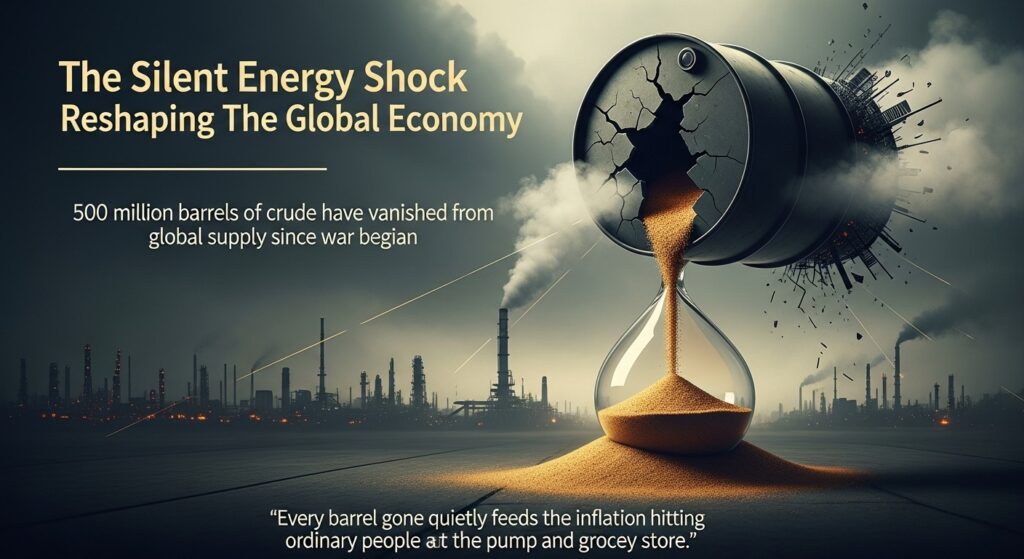
500 million barrels of crude have vanished from global supply since the war began. That’s $45 billion in erased oil, and the economic tremors are only beginning to surface. The biggest energy shock in modern history is unfolding in slow motion, and almost nobody is talking about it.
Since the conflict started, 500 million barrels of crude oil have been taken out of the world’s oil supply. At current market prices, that amounts to around $45 billion worth of energy. This is such a huge loss in energy that it is even bigger than almost every peacetime supply disruption combined. However, this hasn’t raised the alarm that it should have. As a point of reference, think about the 1973 Arab oil embargo it was the incident that shaped a whole generation’s perception of energy vulnerability. That crisis, which sent fuel lines spiraling around city blocks and triggered a global recession, removed a fraction of what the current conflict has wiped from markets. The world’s economic architecture nearly collapsed under that pressure. We are now enduring something measurably larger, with far less public awareness of the stakes.
“Every barrel gone quietly feeds the inflation hitting ordinary people at the pump and grocery store.”
The damage process is quite simple, even though the outcomes may hardly be visible at in the short-run. Each barrel that is taken from the world oil supply cuts down the crude oil market and puts more pressure on the refinery networks which are responsible for turning raw oil into fuels plastics fertilizers, and chemicals that the modern economy relies on. Refineries operating below optimal input levels produce less output. Less output means higher prices, not just at the gas station, but across the entire supply chain downstream.
Grocery prices, freight costs, heating bills, airline fares, all carry embedded energy costs that rise when crude supply contracts. The inflation many households have been experiencing since the conflict began is not incidental to these disruptions. It is, in significant part, a direct product of them.
Part of the reason this shock has not registered more forcefully in public consciousness is the pace at which it has arrived. Unlike the 1973 embargo, which was a sudden, politically dramatic cutoff that caught the markets completely off guard, this supply destruction has been accumulated barrel by barrel, month by month, without any single moment of rupture. Slow-motion catastrophes rarely produce the instinctive urgency that sudden ones do, even when their cumulative damage is greater.
Energy markets have to some extent absorbed the disruption through rerouting, strategic reserve releases, and demand compression in weaker economies. But absorption is not immunity. The pressure building beneath the surface of global energy markets is structural, not temporary — and structural pressures, when they resolve, tend to do so abruptly.
What remains most striking is the silence. Governments have not convened emergency summits. Headlines have not sustained focus on the supply figures. The public, managing rising costs in their daily lives, often lack the frame of reference to connect those costs to the 500-million-barrel hole opening in the world’s crude supply. The gap between the scale of this disruption and the urgency of the global response may itself be one of the defining policy failures of the decade.
The numbers are not abstract. They are reflected in the price of a loaf of bread, a tank of fuel, a winter heating bill. And the prices are still rising.