
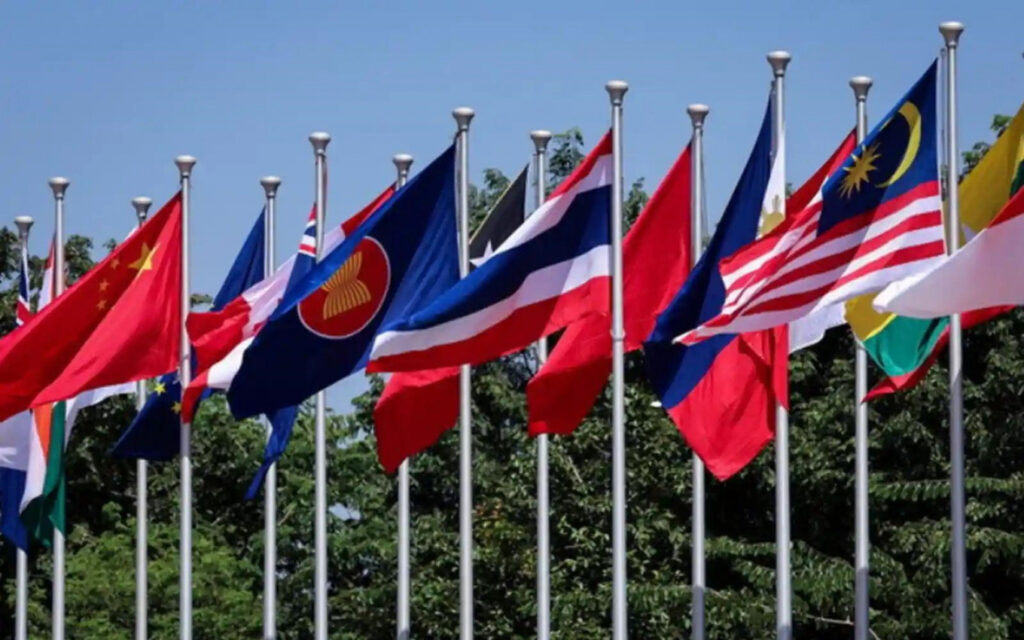
During a virtual emergency summit on April 13, the foreign ministers of the Association of Southeast Asian Nations (ASEAN) 11 countries urged the United States and Iran to develop their fragile ceasefire into a permanent settlement, as Brent crude oil price jumped over $100 per barrel and Southeast Asia confronted the region’s most severe energy crisis in decades.
The Emergency Meeting
The Philippines’ Secretary of Foreign Affairs Ma. Theresa Lazaro was the meeting chair at the 2nd Special ASEAN Foreign Ministers Meeting on the Middle East which supported the two-week ceasefire declared on April 8 2026 However, did not actually say that the emergency situation is over. “To save people from dying, it is very important that the ceasefire be thoroughly and truly carried out,” said the ministers in a joint statement. They also appreciated the mediation efforts of Pakistan between Washington and Tehran. Such concern was not without reason. Over the weekend, US-Iran peace talks in Islamabad at which the American side was headed by Vice President JD Vance broke down with no agreement. The Iranian parliamentary speaker said the US ‘failed to gain the trust of the Iranian delegation.’ Shortly afterwards, President Trump ordered a naval blockade of Iranian ports, which caused the oil markets to plunge.
Hormuz: The Chokepoint That Shook the World
The major concern lies in the Strait of Hormuz a 21-mile wide passage. It is the route through which around 20 million barrels of crude oil and petroleum products were transported each day in 2025. This amounted to 25% of worldwide seaborne oil trade and 34% of all crude oil traded globally, as per the International Energy Agency (IEA). Asian countries receive 89.2% of all crude transiting the strait, making the region acutely vulnerable.
Iran closed the Strait on February 28, 2026, following US-Israeli airstrikes. The IEA called it the ‘largest supply disruption in the history of the global oil market.’ Over 130 container ships became trapped in the Persian Gulf, while Iran’s IRGC conducted 21 confirmed attacks on merchant vessels and reportedly laid sea mines in the passage.
Markets in Freefall
The breakdown of Islamabad talks triggered an immediate market shock. WTI crude surged 7.07% to $103.40 per barrel; Brent gained 6.79% to $101.67. At its March peak, Brent briefly hit $119. UN estimates put the cumulative damage since late February at oil prices up 45%, gas up 55%, and fertilizer prices up 35 According to a model by the Federal Reserve Bank of Dallas, a continuous closure of Hormuz could reduce global real GDP growth by an annualized 2. 9 percentage points in Q2 2026. There were significant drops in Asian stock markets on April 14, with S&P 500 and Nasdaq futures each losing 1.1–1.2%.
Southeast Asia Counts the Cost
ASEAN ministers demanded the restoration of ‘safe, unimpeded, and continuous transit’ through Hormuz under the 1982 UN Convention on the Law of the Sea. The economic pain is already severe: Thailand, which imports 57% of its oil from the Middle East, saw diesel prices spike from 29.94 THB per litre in February to 50.54 THB by April 7. The Philippine peso hit a record low of 60.1 PHP per USD. Vietnam’s Binh Son refinery has crude reserves sufficient only until early July.
ESCAP, the UN agency, has warned that the economic growth in Asia-Pacific could potentially drop from 4. 6% in 2025 to 4. 0% in 2026, while the inflation rate may go up to 4. 6% in the region. Besides, ministers pointed out that food security was a concern as 30% of globally traded fertilizers usually pass through Hormuz – a supply line now virtually cut off. They also confirmed a regional mechanism linking ASEAN with China, Japan, and South Korea to address food and supply disruptions.
What’s Next
Ministers endorsed a proposed ASEAN Foreign Ministers’ Crisis Communications Protocol for rapid future deployment, and the Philippines confirmed it will proceed with the May leaders’ summit focused on food and energy security. ASEAN, which consists of 680 million people and a combined GDP of almost $3. 8 trillion, has clearly stated its demand for peace the question is whether Washington and Tehran are listening, which will largely determine what happens in 2026.