
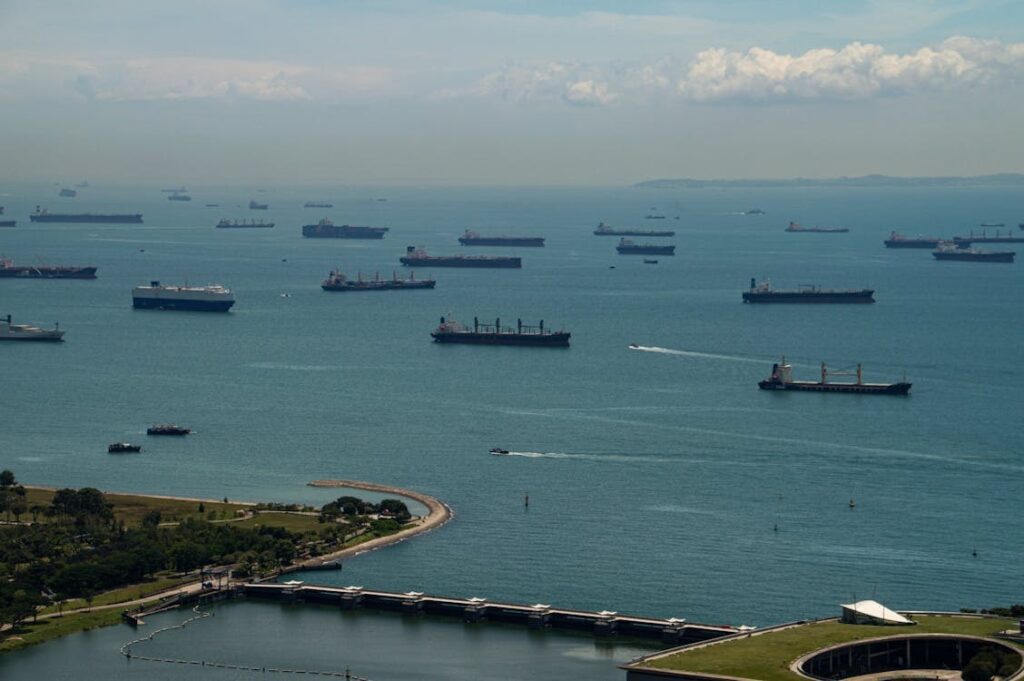
Due to the Iran war, the world economy has stopped at the waters surrounding Singapore. The Iran war still continuing at the seventh week without a ceasefire, vessels going to the Mid-Eastern countries are anchoring at the various Asian ports across the region – basically parking areas for the ships stranded rerouted, and burning cash – according to analysts, this is already being called the most severe maritime disturbance since the oil shocks of the 1970s.
The spark was the 28th of February 2026, coordinated US-Israeli strikes on Iran sending off a series of events that finally caused the closure of the world’s most critical chokepoint. The IRGC announced the closing of the Strait of Hormuz which therefore initially led to a drop in the tanker traffic by approximately 70%, before going down to almost zero. More than 150 ships decided to anchor outside the strait so as to avoid the risks at the same time. The effects were immediate. Maersk, Hapag-Lloyd, MSC, and CMA CGM – the four biggest players in container shipping – all stopped the passage through the strait and started diverting their ships around the Cape of Good Hope in Africa.
That rerouting has transformed Singapore’s already-strained port into a chokepoint of a different kind. The congestion rate in Singapore rose to 43. 3%, with 97 vessels already at the docks and more than a dozen still waiting in line, while China’s Nhava Sheva port was experiencing congestion of more than 60% – from only 10% on March 1 – with 18 container ships waiting outside and 40 currently steaming towards it. Singapore’s congestion hit a high point of 48% before subsiding to 28%, whereas by the 12th of March, Colombo reached 50% and both Tanjung Pelepas and Port Klang in Malaysia are still going up in their levels of congestion.
The numbers tell an unforgiving story. On March 2, Alphaliner reported 138 container ships trapped in the Persian Gulf, accounting for nearly 470,000 TEUs of capacity. About 10% of the world’s container ships are ensnared in the broader backups, with cargo piling up at transshipment hubs across Europe and Asia, according to Ocean Network Express CEO Jeremy Nixon. Transit times have ballooned from 12–18 days to over 30 days due to rerouting around conflict zones.
The energy dimension is equally brutal. The Strait of Hormuz carries nearly half of India’s crude oil imports and about 60% of its natural gas supplies. South Korea sources roughly 60% of its crude via the same route, while Japan relies on it for close to three-quarters of its oil imports. For Pakistan and Bangladesh, the exposure on gas is existential, Qatar and the UAE account for 99% of Pakistan’s LNG imports and 72% of Bangladesh’s. Brent crude surpassed $100 per barrel on March 8 for the first time in four years, reaching $126 per barrel at its peak, while Dubai crude hit a record $166 on March 19.
The insurance market has compounded the pain. After the IRGC declared the strait closed, insurers withdrew war risk insurance, thus livestock tankers that were left damaged, stranded, and commercially unnavigable. To respond to the situation, shipping lines imposed heavy surcharges: CMA CGM announced an Emergency Conflict Surcharge of $2,000 per 20-ft dry container, $3,000 per 40-ft container and $4,000 per refrigerated unit, this being applicable to all cargoes moving to or from Gulf countries Iraq Egypt, Yemen, and their neighbors. At the same time, fuel at Singapore – the world’s major bunkering port – jumped by nearly 200% before it started a gradual decrease, whereas spot rates Asia-to-US West Coast went up by 29% to $2,430 per 40-ft container.
The crisis has not been without diplomatic maneuvering. Several Asian nations, Malaysia, Thailand, and the Philippines among them, negotiated bilateral access through the strait with Tehran, while Iran agreed on March 27 to allow humanitarian and fertilizer shipments through under UN auspices. But these carve-outs are narrow. On March 27, the IRGC declared the strait closed to any vessel going to or from ports of the US, Israel, and their allies, a sweeping prohibition that leaves most of global trade either stranded or subject to Tehran’s political discretion.
The macro toll is severe According to the WTO, the expansion of global trade in merchandise in terms of volume is expected to fall from 4. 6% in 2025 to 1. 9% in 2026 however it is at risk of decline to 1. 4% if oil prices continue to be high. The IMF considers the conflict of 2026 as the greatest supply disruption ever in the global oil market.
Qatar Energy’s declaration of force majeure on all LNG shipments on March 4, after Iranian attacks on its Ras Laffan facilities, removed an estimated 20% of global LNG supply from the market overnight.
Ships collecting dust off Singapore are not merely a logistics inconvenience. They are a barometer of a world order fracturing at its seams, where a single conflict zone can sever the arteries of a $35 trillion global trading system and leave nations scrambling to cut deals with the very power causing the disruption. The longer the war persists, the more permanent this rewiring of global trade could become.