
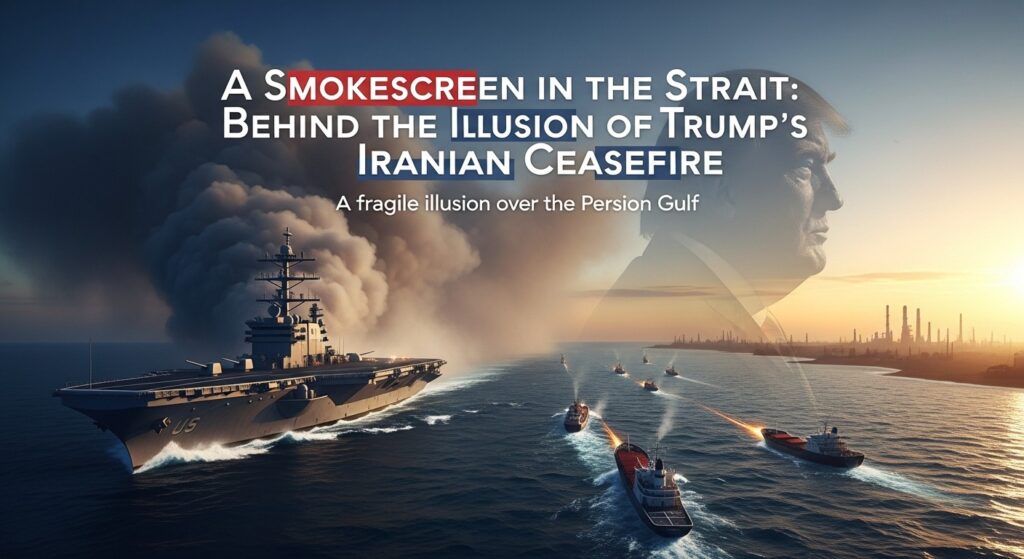
The announcement of an indefinite “ceasefire” with Iran by President Donald Trump is indeed a mask that hides a very dangerous reality, especially when it comes from a place shadowed by the devastating two-month war that has resulted in more than 5,000 civilian deaths. A unilateral declaration of stopping hostilities, based on a request from Pakistani intermediaries and announced on 22nd April 2026, the “ceasefire” situation puts up a facade of diplomatic achievement. Nonetheless, a probe into the administration’s military strategies and secret dealings that followed the announcement shows a ceasefire in name only a fragile illusion over the Persian Gulf.
The crux of the contradiction lies at sea. Even as Trump touts a halt to the aerial bombardments that initiated the conflict on February 28, he explicitly committed to maintaining the U.S. Navy’s blockade of Iranian trade. In international law, a blockade is a definitive act of war.
It’s actually a change of tactics and not a de-escalation. The U. S. Navy’s recent action of intercepting and taking two commercial Iranian ships has caused Tehran to call it “state terrorism and piracy. ” However, Trump went further on social media and threatened that the raising of the blockade could only mean the U. S. “blowing up the rest of their Country, their leaders included. ” By preserving the maritime blockade, Washington is, on the one hand, choking the Iranian economy and, on the other hand, trying to look like the one keeping the ceasefire.
More importantly, the ceasefire extension was not agreed by Iran or Israel the main ally of the U. S. in this conflict formally. Tehran has been harboring not only doubts but also a will to resist, which has actually become stronger after the ‘death’ of the ceasefire demand at the IRGC-affiliated Tasnim News Agency which then issued a threat to break the U. S. blockade by force. The team of Iran’s primary negotiator considers the U. S. break as a mere trick to buy time, a view that is evident from the ongoing Israeli military activities including the recent drone strike in Lebanon’s Bekaa Valley. The region is still on the edge of an explosion.
Besides, the diplomatic effort in Islamabad seems to be just for show. Vice President JD Vance, who was specifically invited by Iranian negotiators, delayed his departure to Pakistan quite a bit this week. He stayed in Washington for secret “policy meetings.” Some sources say that the Iranian officials are unwilling to come back to the table if they are still worrying about naval blockades and threats to their very existence. The lack of senior U.S. officials at the negotiations is indicative that the U.S. is just buying time, putting up a front of diplomacy but actually relying on economic pressure to get the other side to give in.
This international standoff is mainly about Iran’s reserves of highly enriched uranium. Trump’s final aim is totally at odds with Tehran’s adamant position to its civilian nuclear program under the Non-Proliferation Treaty: the former wants to completely remove the uranium so as to make impossible the manufacture of nuclear weapons, while the latter insists on the right to utilize its nuclear program for peaceful purposes. No flexibility has been demonstrated by either side on this fundamental matter.
At the same time, the collateral damage signals that a worldwide catastrophe is beginning. The turmoil has stalled the Strait of Hormuz, has forced hundreds of thousands of people to flee their homes, and has triggered a rise in the price of crude oil to nearly $100 per barrel. The global economy is on the verge of a recession as investors are worried about the recent erratic behavior of Trump’s statements – only two weeks ago he switched very dramatically from warning that the whole civilization will die to announcing indefinite breaks for peace.
In the end, Trump’s announced ceasefire does not indicate progress towards the stability of the region. It is a major geopolitical stalemate. With a naval blockade that is essentially finishing off the economy, no success in peace talks, and major participants in the conflict unwilling to stop fighting, this current “pause” is hardly a stop to the war but rather a moment of surprise before the next inevitable outbreak of hostilities.