
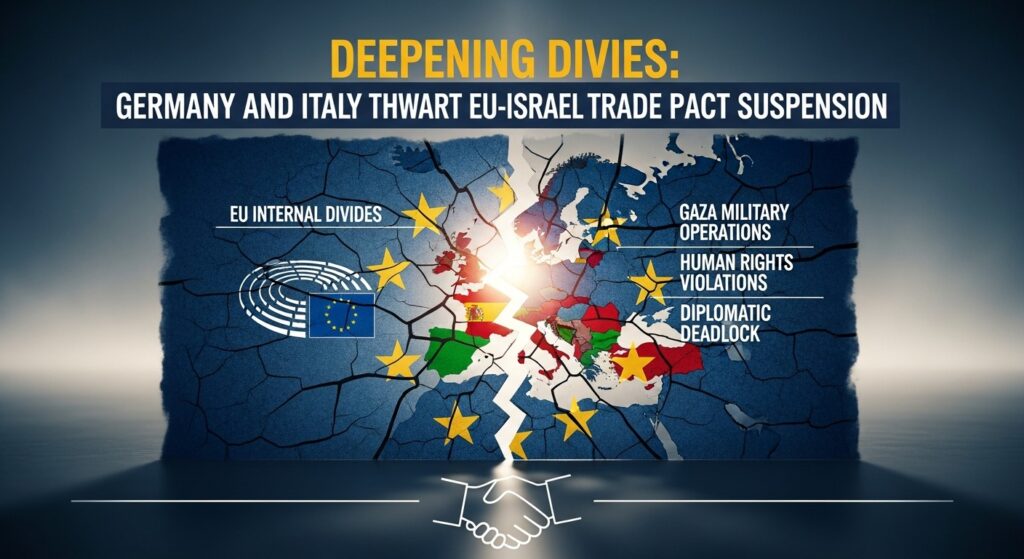
Deepening Divides: Germany and Italy Thwart EU-Israel Trade Pact Suspension
Spain, Ireland, and Slovenia launched a new diplomatic initiative to stop the European Union’s trade agreement with Israel from continuing after all these years but were basically defeated by the firm opposition of Germany and Italy. While meeting in Luxembourg, EU foreign ministers had a very heated argument about what would be the best approach of the EU as a whole to the military operations in Gaza and the increased violence in the West Bank and Lebanon. This has resulted in the exposure of the EU’s internal divides as to the Middle East crisis as some member states do not want to economically punish Israel for the human rights issues.
The removal of the 1995 Association Agreement between EU and Israel was essentially led and promoted by Madrid, Dublin, and Ljubljana. These three countries maintained that the Israeli government, through its actions, has substantially violated the human rights conditions which are set out in Article 2 of the treaty that is our basis. In a letter jointly written to Kaja Kallas, the EU foreign policy chief, the three countries point to the worsening of humanitarian situations. They mention the large number of civilians killed in Gaza, the repeated non-compliance with ceasefire terms, and the lack of humanitarian aid getting to the populations in need as major problems.
In addition, the international alliance has denounced the settler violence happening in an unrestrained way in the West Bank and has also rebuked a highly debated Israeli legislative package that re-introduces death penalty for Palestinians tried in military courts and who kill Israelis. They present these measures as systemic discrimination and oppression. Spanish Foreign Minister Jose Manuel Albares was a big mouthpiece for calling a treaty suspension, pointing out that ignoring the decisions of the United Nations and the International Court of Justice would be a great moral and political disgrace for the whole of Europe. Adding to the seriousness, Kallas recently shared at a Brussels donor conference that the price tag for reconstructing war-torn Gaza has now escalated to a staggering $71 billion.
The suspension proposal however encountered a fast and solid refusal. Germany and Italy spearheading the opposition, totally ruled out cutting off trade relations. German Foreign Minister Johann Wadephul considered the suspension unsupported and the last thing one would expect. Wadephul rather underlined the need to keep an open dialogue, though a tough one, with the Israeli side, which is more important than using economic pressure. Italian Foreign Minister Antonio Tajani was in line with this opinion, telling the media after the session that the idea had been put away for good. While Tajani suggested that different diplomatic moves could be contemplated at the ministerial assembly in May, taking any kind of harsh economic step against Israel has been completely ruled out for now.
This new deadlock is just one episode in a long-running conflict inside Brussels on how to establish a common geopolitical stance. Ireland and Spain tried to push through the revision of the trade agreement in 2024, but the initiative eventually fell apart due to a lack of wider systemic support. Even though a later Dutch-supported report indicated that Israel was most probably violating its international commitments, the decision to impose sanctions was avoided after the Israeli government promised to step up humanitarian aid deliveries. Angered by the collective EU’s lack of action, leading countries have increasingly taken the initiative to pass their own laws. To give an example, Slovenia decided in August to impose rigorous import bans on products coming from illegal Israeli settlements. Then, Spain released a similar order which went officially into force at the start of 2026.
At the same time, the members of the Irish Parliament are making efforts to revive their 2018 Occupied Territories Bill in order to put in place the same trade restrictions. Having already taken the first step of recognizing Palestinian state in May 2024, these three countries still remain at the forefront of the battle for Palestinian rights. However, as evidenced by the recent Luxembourg summit, securing one European line of action is proving to be very difficult.